December 11, 2025
Thought Leadership Matrix
The Thought Leadership Matrix is a two-by-two that plots visibility on one axis and originality of ideas on the other. The four quadrants are aspiring players, popular amplifiers, hidden experts, and industry icons. Most accomplished executives sit in the hidden expert quadrant, with the expertise but not the visibility. Moving toward industry icon status is a deliberate effort, and the matrix is the clearest tool for figuring out which direction to push.
Most senior professionals know they should be doing something about their visibility. Few of them can say, with any precision, where they actually stand today or what "better" would look like. The Thought Leadership Matrix gives you a way to answer both questions on a single page.
A lot of senior professionals know they need to do something about their thought leadership. Fewer of them can tell you, in concrete terms, where they actually stand. The vocabulary tends to go vague fast. I should probably post more on LinkedIn. I've been meaning to write something. I keep getting asked to speak and I should say yes more often. Those instincts are fine, but they don't add up to a picture.
The Thought Leadership Matrix gives you the picture. It's a two-by-two that plots visibility against originality of ideas, and once you've located yourself on it, the next move tends to become obvious.
The two axes
The horizontal axis is visibility. On the far left, no one knows you. On the far right, you're a household name within your industry, or even beyond it. This is reach, recognition, and the simple question of whether your name surfaces when the right people are looking for someone who does what you do.
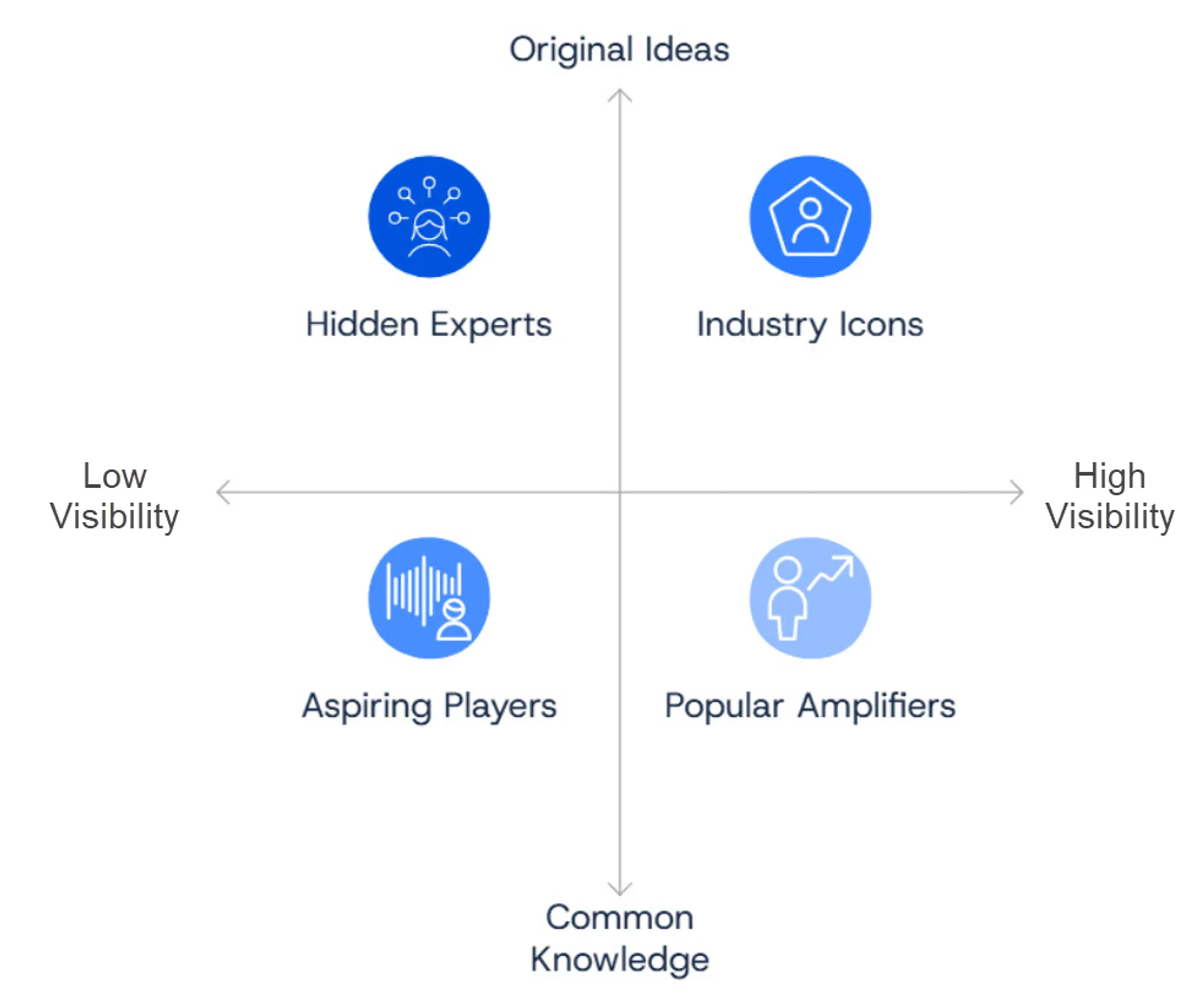
The vertical axis is the originality of your ideas. At the bottom is common knowledge, the stuff anyone in the field could repeat. At the top are genuinely new insights, the ideas that move an industry forward or challenge an assumption that the rest of the field is still operating on.
Cross those two axes and you get four quadrants. Each one describes a different position in the market, and each one calls for a different next move.
Quadrant one: The aspiring player
Lower left. Low visibility, low originality.
This is where most people start out. The aspiring player doesn't yet have new ideas to share and doesn't yet have an audience to share them with. There's no shame in this position. Everyone passes through it. The work from here is to build in both directions at once, which is hard, but the upside is that there's nowhere to go but up.
Aspiring players who try to skip ahead by chasing visibility before they have anything original to say end up producing the kind of content that hurts more than it helps. The research is consistent on this. Sixty-five percent of decision makers say that poor thought leadership actively damages how they view a company. Volume without substance is a step backward.
Quadrant two: The popular amplifier
Lower right. High visibility, low originality.
Popular amplifiers are everywhere. They have real reach, real audiences, and they're often very good at what they do. What they're not doing, generally, is generating new ideas. They're packaging widely accepted advice for an audience that benefits from hearing it clearly and often.
Dave Ramsey is the textbook example. Enormous platform, enormous reach, and the financial advice itself is broadly conventional. He's not going to win a Nobel for new monetary theory, and that's not his goal. His goal is to get proven principles in front of the people who need to hear them. Bill Nye the Science Guy is the same shape. He's not advancing physics. He's making it accessible to kids, and he's spectacular at it.
This quadrant is a legitimate place to operate. It's just not the same thing as thought leadership in the strict sense.
Quadrant three: The hidden expert
Upper left. Low visibility, high originality.
This is where most accomplished executives and board candidates actually live, whether they realize it or not. The hidden expert has decades of experience, real pattern recognition, genuinely original perspectives on the problems their industry is wrestling with. What they don't have is the audience.
The Amazon analogy is useful. There are authors with five-star reviews and fewer than ten of them. The people who found the book loved it. Almost no one found the book.
Edwina Dunn is a real example. In retail analytics, she's one of the top experts in the world, the cofounder of dunnhumby, which built the customer data work behind Tesco's Clubcard. When she shifted toward empowering women in business and wrote a book on the topic, the work was strong and the reviews reflected it. The reach was modest. Sheryl Sandberg wrote Lean In on a closely related topic and accumulated more than seventeen thousand reviews. Same subject, vastly different reach.
The hidden expert quadrant is the one with the most untapped value, because the foundation is already built. The expertise is real. The pattern recognition is real. What's missing is the visibility infrastructure, and that's a problem with a known solution.
Quadrant four: The industry icon
Upper right. High visibility, high originality.
Industry icons have both. They've put forward ideas that shaped the field, and they've built the platform to make sure those ideas reached the people who needed them. Warren Buffett is the obvious investing example. Sheryl Sandberg occupies this quadrant in the women-in-leadership conversation. In any healthy industry, you can name three or four people who sit here.
What's worth noticing is that industry icons aren't always the people with the deepest expertise in their field. They're the ones whose expertise became visible. Plenty of people who could have been icons are still hidden experts, because they never built the second axis.
Where the leverage is
Walk a senior executive through this matrix and the conversation almost always goes the same way. They place themselves somewhere in the hidden expert quadrant, sometimes generously, sometimes harshly. Then they ask the obvious next question. What does it actually take to move?
The honest answer depends on which axis you're trying to move along.
Moving up the originality axis is about doing the thinking. It means getting clear on the problem in your industry that you want to be known for solving. It means developing a point of view sharp enough that someone could disagree with it. It means building a signature framework that captures your perspective in a way someone can sketch on a napkin and remember a week later. This work is harder than it looks, because your real opinions are buried under decades of polite professional hedging. Mining them out takes deliberate effort.
Moving right on the visibility axis is about doing the publishing. It means showing up consistently on the channels where your audience already is, which for most B2B executives means LinkedIn. It means publishing into a coherent strategy rather than posting whenever inspiration strikes. It means engaging thoughtfully with the people who are already industry icons in your space, because their networks become your networks over time.
The leverage point for most hidden experts is to start with originality and build out from there. The reason is that visibility without substance produces lowest common denominator content, the kind that fills LinkedIn feeds and convinces no one. Visibility with substance compounds. One sharp framework, published consistently, supported by a body of related content, gets remembered. It gets quoted. It eventually gets surfaced when someone asks an AI assistant who the experts in your space are, because LinkedIn is now the number one source the large language models cite for professional content.
The matrix as a planning tool
The most useful thing about the matrix isn't the diagnostic. It's the planning conversation it forces.
If you place yourself as a hidden expert, the question becomes which two or three visibility moves over the next ninety days would meaningfully shift your position. Maybe it's a cornerstone article on LinkedIn that lays out your framework. Maybe it's saying yes to three speaking opportunities you've been deferring. Maybe it's a deliberate effort to engage with the existing industry icons in your space so your name starts circulating in their networks.
If you place yourself as a popular amplifier, the question is what original perspective you've been sitting on but haven't yet committed to publicly. There's usually one. The reach is already there. What's missing is the substance that would let you graduate to icon status.
If you place yourself as an aspiring player, the question is which axis to push first, and the honest answer is usually originality, because you can't outrun a lack of substance with volume.
And if you place yourself as an industry icon, the question is how to defend the position, because the AI saturation of content means competitors who couldn't have reached your audience five years ago can now show up in the same search results you do.
A final word on the goal
It's worth saying what this is all for. Becoming visible isn't an end in itself. It's the mechanism by which the right opportunities, board seats, advisory roles, partnerships, speaking invitations, find their way to you instead of to someone less qualified who happened to be more findable.
The old framing was that opportunity is about who you know. The honest version is that it's about who knows you. The Thought Leadership Matrix is the clearest way to figure out how many of the right people know you today, and what it would take to make that number meaningfully larger by the end of the year.
Place yourself honestly. Pick the axis where the leverage is. Get to work.
About the author

David Kochanek
Founder
I help executives and companies build authority, visibility, and trust with thought leadership marketing and executive branding.